You leave the supermarket, put the bags on the kitchen counter, and realise you've spent at least 30% more than you had in mind. You didn't even notice it happening. And yet, here you are again.
It's not distraction. It's not a lack of willpower. It's neuroscience applied to retail — and understanding how it works is the first step toward stopping it from happening.
The brain that shops is not the brain that plans
When you plan your shop at home, you use the rational part of your brain: you reason, evaluate, decide. When you're inside the supermarket, tired after a long day, with background music playing and your stomach starting to rumble, that rational part gradually hands over control to something more automatic, more impulsive, more easily influenced.
Psychologists call this system switching — the shift from slow, deliberate thinking to fast, instinctive thinking. Retailers know it well. And they build the in-store experience precisely to encourage that shift.
Hunger isn't just physical
One of the most cited experiments in consumer behaviour research involves hunger. Researchers observed that people who shop on an empty stomach buy on average 64% more products than those who shop after eating — and not just food, but non-food items too, like batteries, cleaning products and household supplies.
The mechanism is straightforward: hunger triggers a general state of urgency. The brain, in "acquire resources" mode, lowers its threshold for purchase control. Everything seems more necessary, more urgent, more justified.
The advice to never shop hungry is as old as supermarkets themselves — and yet almost nobody actually follows it.
Tiredness as a spending multiplier
Hunger is the most well-known factor, but tiredness is probably the most underestimated. After a full day of work, your brain has already made hundreds of small decisions. That decision-making capacity is a finite resource — psychologists call it ego depletion, or cognitive exhaustion.
When you're tired and standing in front of a shelf with twelve versions of the same product, your brain takes the path of least resistance: it picks the familiar one, the one within easy reach, the one on promotion that already feels like a decision made for you. Thinking takes energy you no longer have.
It's no coincidence that supermarkets record their highest average basket values during evening hours, when people are coming home from work. Not because people want to spend more — but because they have fewer cognitive resources left to resist.
The cognitive biases that drain your wallet
Beyond hunger and tiredness, several very specific psychological mechanisms come into play.
The anchoring effect
When you see a product with the original price crossed out and the discounted price highlighted, your brain uses the original price as a reference point. Even if you would never have paid that amount, the discount feels like a gain. You buy something you didn't need because it feels irrational not to.
Perceived scarcity
"Only 3 left", "Today only", "Limited quantities". These messages trigger the fear of missing out — what researchers call FOMO. The brain responds with urgency, bypassing rational evaluation entirely.
The halo effect
One app for your whole household
Shopping lists and loyalty cards on every device — free to start, Pro when you want to share in real time.
A product labelled "organic", "artisan" or "locally sourced" tends to be perceived as better across the board — healthier, tastier, better value — even on attributes that have nothing to do with those claims. We pay a premium for a sense of quality we haven't actually verified.
Choice fatigue
Paradoxically, the more options you have in front of you, the harder it is to decide — and the more you tend to go with the default or the most visible option. Retailers know this: which is why the products they want to push occupy the central shelf positions, right at eye level and arm's reach.
Mental list vs written list: they're not the same thing
Here's a thought experiment worth trying. Think of the last time you went to a supermarket with a written list in hand. Then think of a time you went in thinking "I know what I need". Was the outcome — in terms of time spent, items bought and final bill — the same?
The mental list has a structural problem: it doesn't really exist. It exists as a vague set of intentions, subject to constant interference. The moment you walk into the store, the environment starts overwriting it: a smell, a promotion, a product you haven't seen in years. The mental list dissolves progressively, replaced by whatever the moment throws at you.
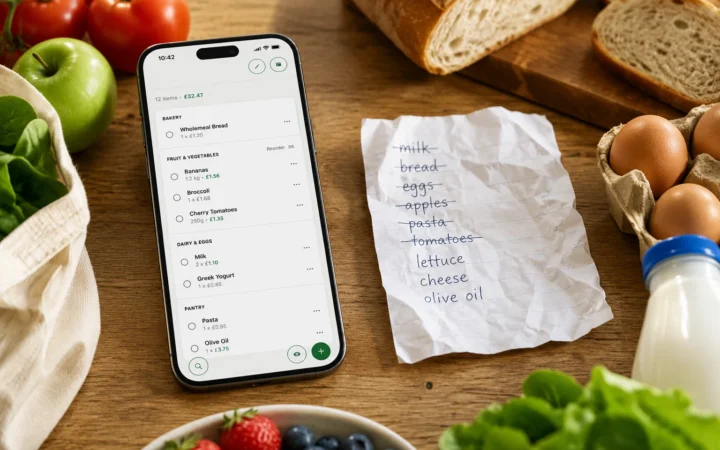
A written list, on the other hand, is an externalised commitment. You don't have to remember — you just have to follow. This frees up cognitive resources for what actually matters: assessing quality, comparing prices, making conscious decisions.
Research on consumer behaviour confirms that shoppers who use a written list tend to buy fewer unplanned items and report greater satisfaction with their purchases — because they feel they maintained control over their budget rather than being steered by the environment.
The problem with a generic written list
A written list is already a big step forward. But not all lists are equal.
A generic list — "milk, pasta, tomatoes, shampoo" — protects you from forgetting things but doesn't protect you from distraction. You know what to buy, but not in what order to look for it, which aisle to find it in, or how long it will take. The route stays chaotic, and every detour is an opportunity for the supermarket to work its magic.
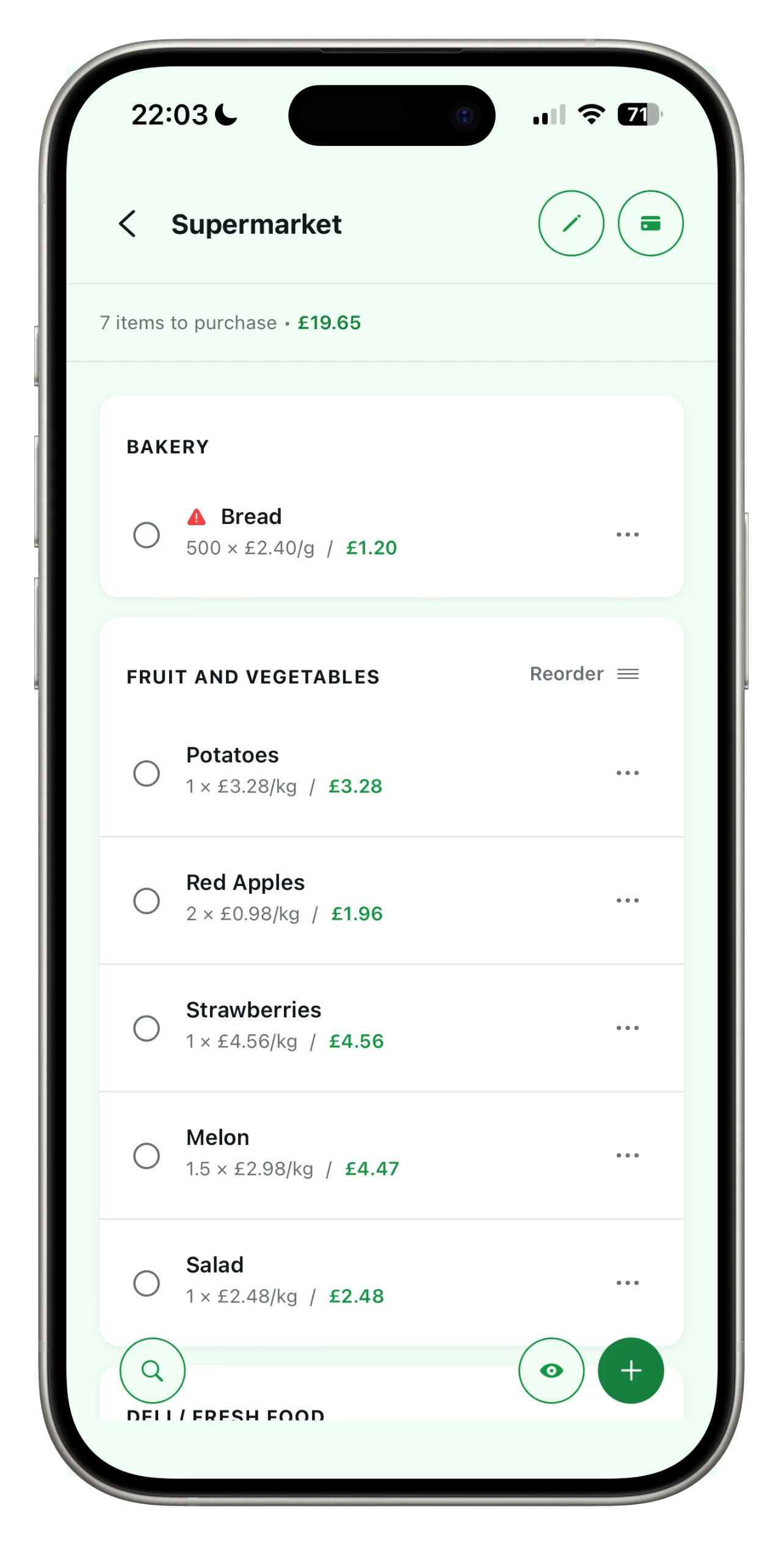
A list organised by department is a level above: it's a map as well as a reminder. You know where to go, in what sequence, and you can move through the store in a straight line. Less time between the shelves means less exposure to stimuli, fewer impulse decisions, fewer unplanned items in the trolley.
How Spesary helps your brain shop better
Spesary is designed with a clear understanding of how the shopping process actually works — not how we'd like it to work.
Permanent lists let you build, over time, a list organised by department, calibrated to your regular store. You don't have to reconstruct it from scratch every week: it's already there, up to date, ready to go. This reduces cognitive load before you even set foot in the shop.
Arriving with a clear, organised plan is precisely the condition in which the brain is most resistant to environmental stimuli. You don't have to improvise, you don't have to remember, you don't have to decide under pressure.
The supermarket doesn't stop being an environment designed to make you spend more. But with the right tools, you can walk in on your own terms.