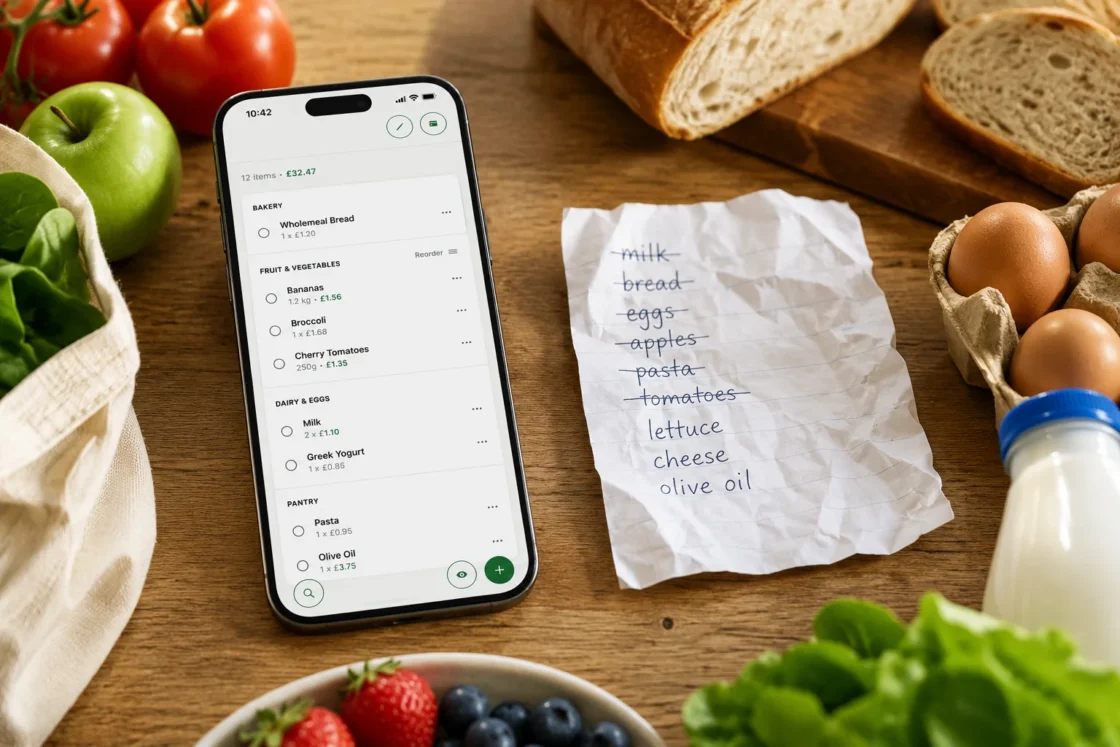
There's a ritual that repeats itself every week in millions of homes. Someone opens their phone, picks up a piece of paper, or starts typing in a notes app, and begins writing down what's missing: milk, bread, yoghurt, pasta, washing powder. They get to the supermarket, do the shop, and that list disappears — thrown away, deleted, forgotten. The following week, they start from scratch.
It's a system that works. Or at least, it seems like it does.
But there's another way of doing things. And once you try it, it's hard to go back.
What a disposable list is
The disposable list is the one almost everyone knows. It's created shortly before heading to the supermarket, gathers whatever you remember having run out of or needing, and gets abandoned as soon as the shopping is done.
It might be a piece of paper, a WhatsApp message, a note on your phone. The format changes, but the logic is always the same: it's born in the moment of need and dies the moment that need is met.
It has its advantages. It's quick to create, requires no maintenance, and commits you to nothing. For anyone who shops occasionally or very irregularly, it can be more than enough.
But it has one important structural limitation: every time, you start from zero. And starting from zero means relying entirely on your memory in that moment — which is by definition partial, shaped by tiredness, mood, and how much time you have.
The short-term memory problem
When you put together a list on the fly, you easily remember things that ran out recently: the milk that finished this morning, the pasta used last night. What's much harder to remember is what's about to run out, what you use rarely but regularly, what ran out last week but has already slipped into the background amid the busyness of daily life.
The result is a shop that covers the urgent well but neglects the necessary. You come home with milk but no salt. You remembered shampoo but not conditioner. You bought pasta but forgot the stock cubes that ran out three days ago.
And then you go back to the supermarket mid-week. Or you make do.
What a permanent list is
A permanent list works in a completely different way. It isn't created and thrown away: it always exists, it updates over time, and it reflects the real habits of whoever uses it.
The basic idea is simple: instead of starting from scratch every time, you begin from a consolidated base — the products you buy regularly — and add or remove what changes week to week. The list isn't a single-use tool: it's a living archive of your shopping habits.
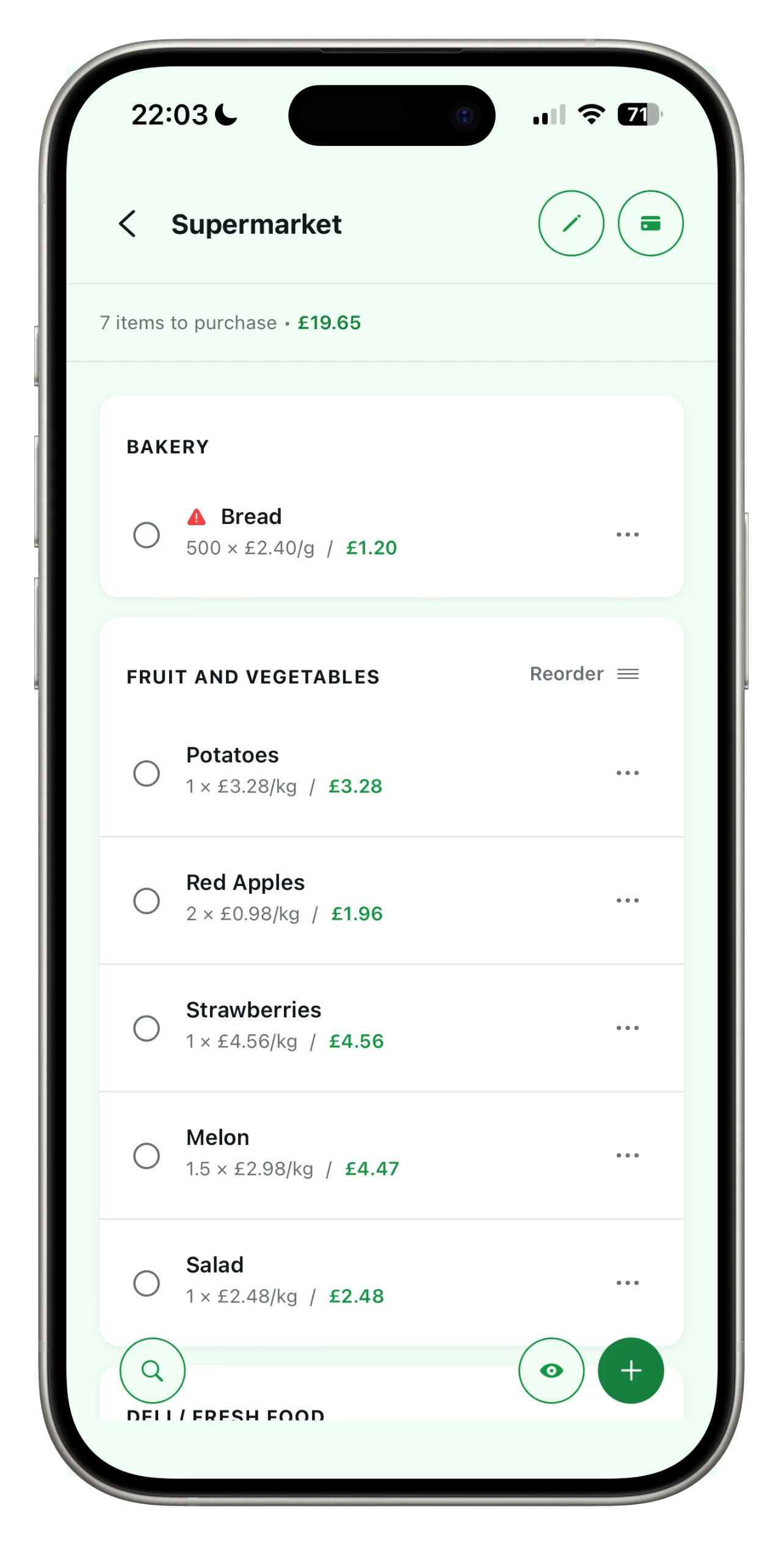
In practice it works like this: the first time, you build the list carefully, adding all the products you habitually buy. From the next shop onwards, you reactivate what you need and add any exceptions. What's been bought gets ticked off, but stays ready to come back next time. Over time, the permanent list becomes richer and more precise.
The value that builds with every shop
The most subtle advantage of a permanent list isn't the immediate convenience — though that's there too. It's the value that accumulates over time.
A disposable list always has the same value: whatever it was worth in the moment it was written. A permanent list is worth more every time you use it, because every shop adds information, refines the categories, consolidates habits.
One app for your whole household
Shopping lists and loyalty cards on every device — free to start, Pro when you want to share in real time.
After a few months of use, a well-maintained permanent list contains something genuinely valuable: an accurate picture of how you eat, what you consume, and how often you need certain products. It's a store of information that no disposable list can ever build, by definition.
This becomes particularly useful in specific situations. When you come back from a holiday and need to restock the house from scratch. When the season changes and your eating habits change with it. When you need to delegate the shopping to someone else — a partner, a family member — and you want it done exactly as you would do it yourself.
Permanent lists and shared lists: the step change for families
The advantage of a permanent list multiplies when you live with family or other people. A shared, permanent list becomes the most effective coordination tool you can have for everyday shopping.
Everyone can add what they notice is missing during the week — without having to wait for shopping day to mention it. Whoever goes to the supermarket finds a list that's already complete, updated in real time by everyone in the household. No more calls halfway down the aisle ("did you write yoghurt or Greek yoghurt?"), no more duplicates because two people added the same product without knowing, no more forgotten items because someone noticed something had run out but didn't get round to saying so.
The shared permanent list turns shopping from an individual task into a family system. And systems work better than intentions.
When you need a different list
In real life, alongside the weekly routine shop, there are moments that call for something different. The shop for a Christmas dinner. Products for a week of houseguests. Ingredients for a special recipe you never normally make. Situations where what you need is far from your usual routine, and it makes no sense to mix those products into your permanent list when you'll only use them once.
The solution isn't to abandon the system: it's to create a separate list for that specific occasion. A parallel, dedicated list that lives alongside the permanent one without interfering with it. Once the dinner is done, the list has served its purpose — without anything from that one-off shop cluttering the structure you've built over time.
In Spesary you can have multiple active lists at the same time. The weekly list for your regular supermarket, one for the Saturday market, and a temporary list for the New Year's Eve dinner — all separate, all organised, all shareable with whoever you like. Each list has its own logic, its own purpose, its own lifecycle. Some last years. Others last an evening.
It's this flexibility that makes the system genuinely useful: it doesn't force you to choose between structure and freedom, but holds both together.
How Spesary brings it all together
Spesary is built around the concept of the permanent list, without sacrificing the flexibility you need for occasional additions.
Permanent lists in Spesary can be organised by department, so your shop follows a logical route through the supermarket without zigzagging between aisles. Products can be ticked off during the shop and reactivated for next time, keeping the structure you've built intact.
With Spesary Pro, lists can be shared with family members, who can add products in real time from any device. The list is always up to date, always available, always ready.
The result is a shop that gets better week after week — not because you're working harder, but because over time you've built a list that works for you.