How many times have you opened the fridge mid-week and found half-wilted vegetables, an open jar of sauce that's been there for days, something wrapped in cling film you don't even remember buying? And how many times, in that same moment, did you have no idea what to cook — despite the fridge being full?
It's not a problem of abundance. It's a problem of system.
Doing your weekly shop without food waste doesn't mean buying less. It means buying with a logic. And that logic has a name: planning. And it's not as complicated as it sounds.
The real cost of food waste
Before talking about solutions, it's worth pausing on the problem. The average household throws away hundreds of pounds of food every year. Not because anyone wants to — nobody buys food intending to throw it away — but because they shop without a plan and then real life gets in the way: the last-minute dinner out, the busier-than-expected week, the lunch that never happened.
Household food waste doesn't start in the fridge. It starts at the supermarket, in the moment when products go into the trolley without a clear idea of exactly when and how they'll be used.
Planning your meals isn't a complication — it's a liberation
There's a widespread idea that planning weekly meals is something for perfectionists or families with a lot of free time. In reality, it's the exact opposite: people who plan their meals spend less time wondering what to cook, make fewer trips to the supermarket, waste less food and — often — eat better too.
Meal planning, in its simplest form, is this: before you shop, decide broadly what you'll eat during the week. You don't need a detailed calendar with every meal planned to the minute. A rough idea — three or four dinners, a few lunches, breakfast — is enough to build a shopping list that actually makes sense.
The difference between a planned shop and an instinctive one is the difference between buying ingredients for four specific recipes and buying whatever looks good in the moment, hoping it will all come together somehow.
The method: from the cupboard to the list, via the meals
A good weekly shopping cycle always follows the same logical sequence. It's not a rigid formula — it's a flow that, once internalised, becomes automatic.
The first step is looking at what you already have. Before writing any list, open the fridge, check the cupboards, look at what needs to be used soon — the vegetables bought last week, the almost-finished cheese, the remaining eggs. What's already there shapes what you need to buy, and often suggests a few meals on its own.
The second step is deciding the week's meals. Not necessarily all of them — a rough structure is enough. How many dinners will you eat at home? Are there lunches to take to work? Is there a day you already know you'll be eating out? This information determines how many portions you need and for how many meals.
The third step is building the list from the meals — not the other way around. If you decide to make a pasta bake on Tuesday, you add the ingredients you're missing. If you want a soup on Thursday, you check whether you have the right vegetables or need to buy them. The list comes from the meals, not the meals from the list.
The fourth step is adding your routine products. Breakfast items, snacks, household essentials, things you consume regardless of what you're cooking. These live in the permanent list and don't require a decision every time: they're always there, updated when they run out.
Recipes as the bridge between list and meal
One thing that fundamentally changes your relationship with the weekly shop is having a reference repertoire of recipes — not necessarily elaborate ones, but dishes you know, enjoy, and whose ingredients you have in your head.
Someone who regularly cooks the same twenty or thirty recipes has an enormous advantage: they already know what to buy, in what quantities, and how to combine ingredients to avoid unnecessary leftovers. A leftover chicken thigh becomes the topping for a salad the next day. Thursday's grilled vegetables become the filling for a Friday frittata.
This approach — cooking with a sense of continuity between meals — is one of the most effective ways to reduce waste without giving up variety. You're not eating the same thing every day: you're using the same ingredients in different ways, with fewer leftovers and fewer products expiring at the back of the fridge.
Portions: the detail that makes the difference
One app for your whole household
Shopping lists and loyalty cards on every device — free to start, Pro when you want to share in real time.
One of the most common mistakes in weekly shopping is buying without thinking about portions. You pick up a 500g packet of pasta without knowing how many people you're cooking for or how many times you'll make it. You buy a head of lettuce without considering that it'll only be half used before it wilts.
Thinking in portions — how many people are eating, how many times a week, how much you typically get through — lets you buy the right quantities instead of trusting your instincts. It's not an exact science: it's an estimate that becomes more precise over time, because you learn from your own mistakes and recurring leftovers.
If you find yourself throwing away half a bag of spinach every week, buy half a bag. If the bread always has some left over, buy less — or freeze the extra. Recurring waste is a precise signal about where your shopping system needs adjusting.
Storage as part of the plan
One often-overlooked aspect of waste-free shopping is managing what you buy once it gets home. Buying well is only half the work: storing well is the other half.
A few practical principles that make a real difference. The most perishable fresh products should be used first — it's better to plan meals with fresh fish or meat at the start of the week, and save dishes based on pulses or pasta for later. More resilient vegetables — carrots, cabbage, courgettes — hold up better in the fridge and can wait.
The freezer, used intelligently, is one of the most powerful tools against food waste. Leftover bread gets frozen in slices. Meat bought on offer gets portioned and stored. Leftover sauce gets frozen for a future meal. It's not a fallback: it's conscious management of the resources already in your home.
Flexibility: the plan that knows how to adapt
One of the psychological barriers to planning is the fear of being rigid. And that's partly understandable: real life doesn't follow perfect plans. You stay late at the office, you get an invitation to dinner, you simply want something different from what you'd planned.
A good weekly plan isn't a programme to follow to the letter: it's a flexible structure that guides without constraining. If on Wednesday you go out for dinner instead of making the pasta bake you'd planned, that pasta bake moves to Thursday. If the chicken doesn't get used, it goes in the freezer. The plan isn't a contract — it's a compass.
Flexibility only works, though, if you started with a structure. Without a base plan, every change becomes total improvisation. With a plan, every change is just a small adjustment.
How Spesary supports your weekly shop
Spesary is designed to support exactly this flow — from planning to shopping, without friction.
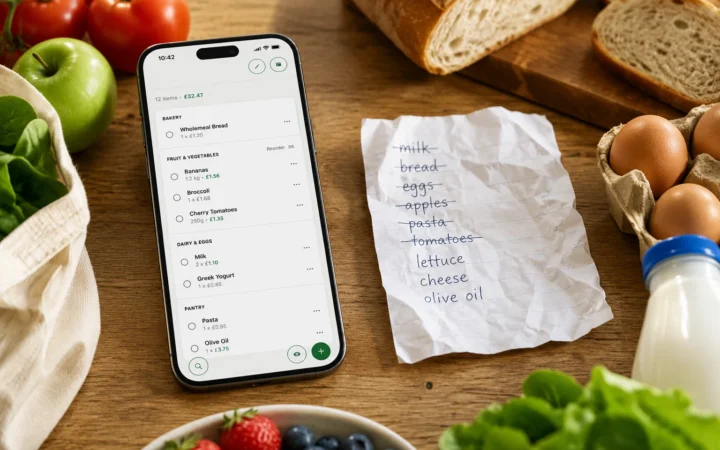
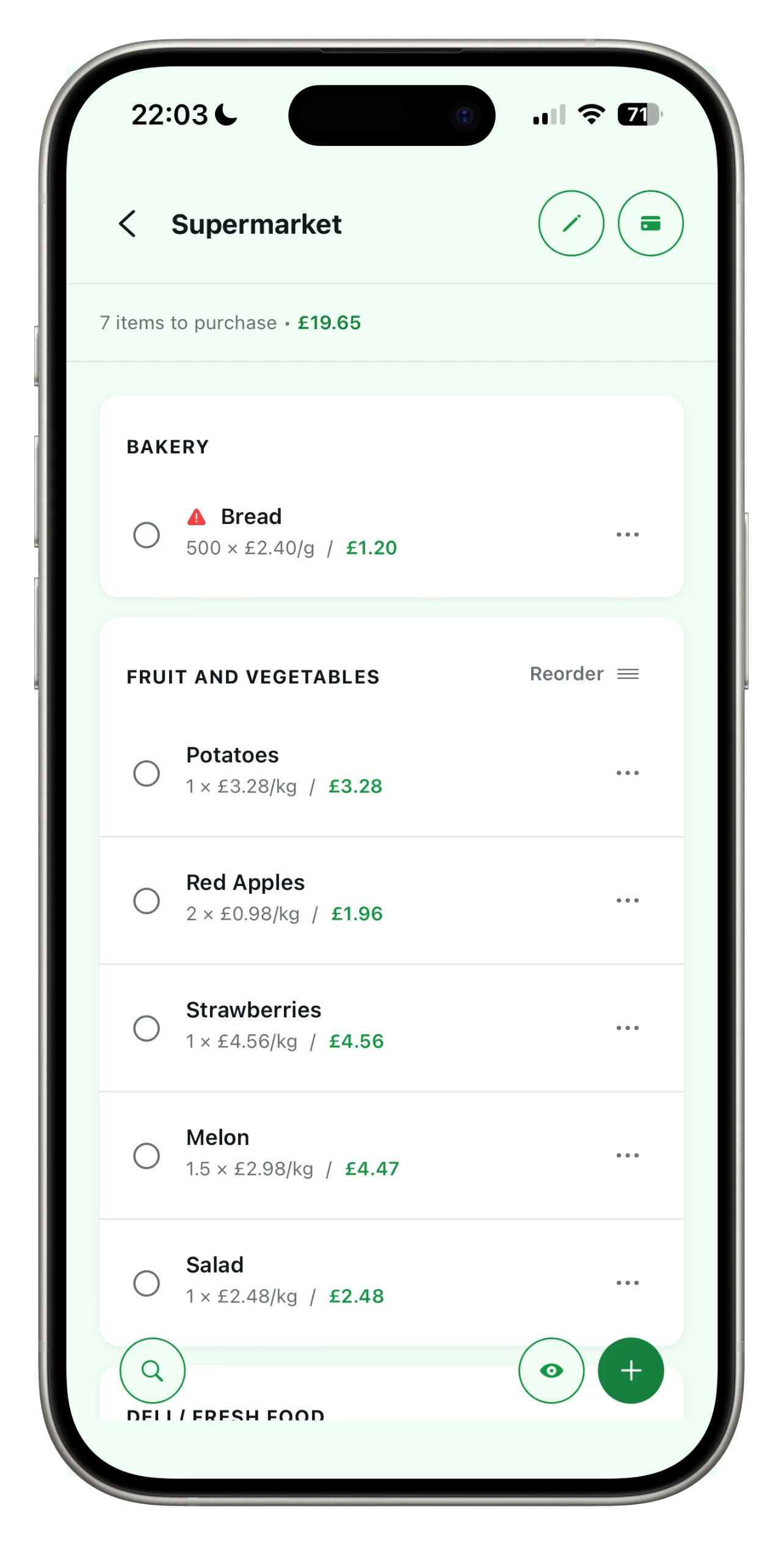
Permanent lists hold your routine products, organised by department, ready to be reactivated each week without starting from scratch. The structure built over time — which products, which department, in what sequence — stays there, stable, and improves with every shop.
When the week calls for something different — a special dinner, ingredients for a new recipe, products for guests — you create a separate list, dedicated to that occasion, which doesn't interfere with the permanent structure. Every list has its own purpose and its own lifecycle.
With Spesary Pro, the whole family can contribute to the list in real time. Whoever notices the milk is running low adds it straight away, without waiting for shopping day. Whoever plans the week's meals adds the missing ingredients as they go. The list is always up to date, always ready, built by everyone for everyone.
The result isn't just a more efficient shop. It's less stress, less waste, fewer unnecessary trips to the supermarket — and more time for the things that actually matter.