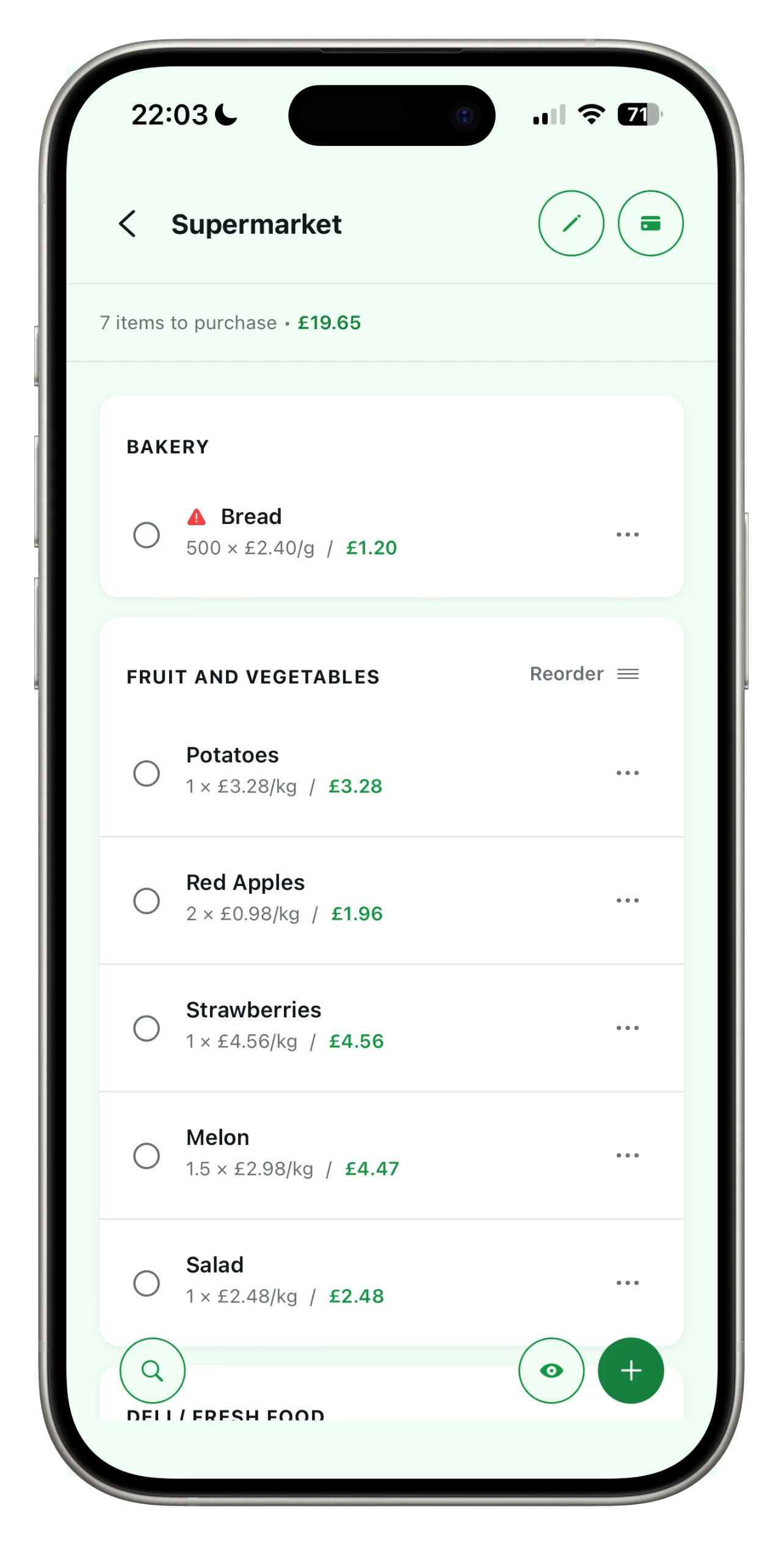
There's a moment that repeats itself in almost every home. One person is at the supermarket, the other is somewhere else, and a quick text goes back and forth between them. "Do we need milk too?" "Did we already buy eggs?" "I can't remember if we're out of detergent." Small questions that pile up and eat into time, attention, and sometimes patience too.
With a shared list, that back and forth mostly disappears. Not because an app does anything magical, but because both people are looking at the same thing, updated at the same moment. Here are three real situations that show the difference.
When One Person Has Never Written a List in Their Life
Silvio had never used his phone to jot down what to buy. It always worked the same way: his wife Ebru would text him on WhatsApp with things to pick up, he'd reply "got it" and then try to remember all of it while walking the aisles.
Ebru started using Spesary to keep the household list, and at some point she just had Silvio install the app too. No tutorial, no long explanation. Now when he heads home from work and stops by the supermarket, he opens the app and finds everything already there, added throughout the day by whoever was home. He doesn't have to decode a message typed in a rush. He just reads a list.
When One Person Updates and the Other Shops on the Way Home
Danilo works from home, and like many people who do, he notices right away when something runs out. Coffee, milk, toilet paper. If he sees supplies getting low during the day, he adds them to the list on the spot instead of waiting until evening to remember.
His wife Alba works outside the house, and sometimes decides to swing by the supermarket on her way home without even a heads up. All she has to do is open the list, already organized by store aisle, to know exactly what to grab. No phone call to check, no rebuilding the list from scratch every week. Danilo and Alba's list never resets. It just keeps updating.
When Shopping Together Actually Gets Faster
One app for your whole household
Shopping lists and loyalty cards on every device — free to start, Pro when you want to share in real time.
Francesca and Riccardo do their grocery shopping together on Saturdays, like a lot of couples. The problem is that supermarkets on Saturday are packed, and walking the aisles side by side often slows things down instead of speeding them up.
Their fix is simple: they split up the sections. One heads to produce, the other to frozen foods, and neither has to keep track of what the other is picking up. With a shared list that updates in real time, each of them can see right away what's already in the cart and what's still missing. No duplicate milk, no walking back and forth to ask "did you grab the bread?"
What These Three Stories Have in Common
Silvio and Ebru, Danilo and Alba, Francesca and Riccardo all shop differently from one another. One person shopping solo, two people splitting tasks across the week, a couple shopping together on weekends. But in all three cases, the starting problem was the same: keeping two people on the same page about what to buy, without wasting time on texts, phone calls, or lists rewritten from scratch.
A shared shopping list doesn't do the shopping for you. It solves the coordination part, which is often the more tiring bit. And once it's set up, it stays there, ready, updating itself as you use it.
If you want to see step by step how to turn it on, how the QR code or link invite works, and how to manage who can edit the list and who can only view it, you'll find it all in the shared shopping list guide.