A string of food recalls published by Italy's Ministry of Health in recent days tells a story that goes beyond any single incident. Different products, different brands — and yet the same type of problem, the same product category, sometimes the very same production facility. We covered one such case just days ago: a large-scale recall of frozen croissants where the name on the label turned out not to be the company that actually made them.
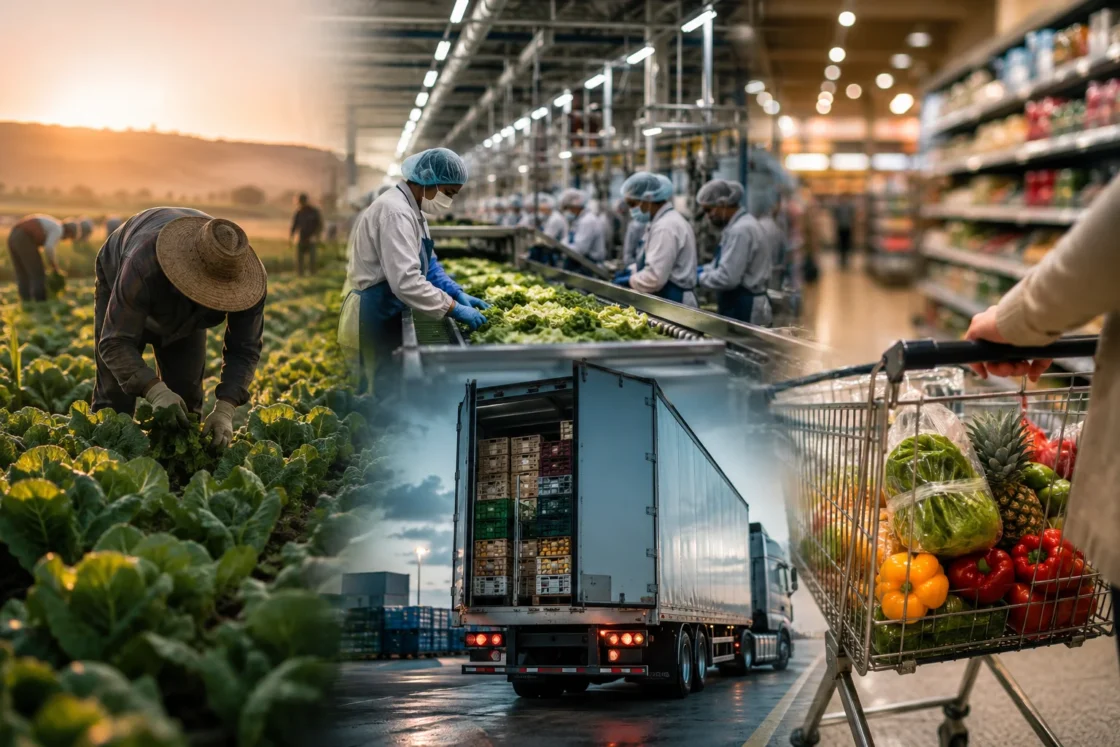
This is not an anomaly. It is simply how food gets made — everywhere. Behind the brand you recognise on the shelf, there is almost always a company that produces for others too, sometimes for several brands that sit side by side as if they were rivals. The practice is called co-packing, or, when the finished product carries the retailer's own name, private label. It is legal, regulated, and economically central to how modern food retail works. It is also something most shoppers know little about — and it is worth understanding properly, because it changes how you read a label and, above all, how you make sense of a recall.
What it actually means when a company "produces for others"
The mechanics are simpler than they sound. A food company builds a facility, a production line, a network of raw material suppliers. That facility has a capacity that, to be economically viable, must run as close to full as possible. Selling only under its own brand, however, means depending entirely on that brand's ability to move enough volume to keep the lines busy. So many companies take a different path: they use part of their capacity for their own brand, and the rest to manufacture on commission for third parties — producing a product to a client's specifications, whether that client is another food company or a supermarket chain directly, and labelling it under the client's name.
For the supermarket or discount retailer commissioning the product, the advantage is clear. No facility to build, no supply chain to manage, no marketing or advertising spend needed to establish a name. They buy a finished product, put their label on it, and sell it at a lower price precisely because the cost of brand-building is not baked in. For the producer, the logic is equally straightforward: fuller lines, fixed costs spread across higher volumes, and a stable client with recurring orders — all without having to compete on the shelf under their own name.
It is worth distinguishing two situations that often get conflated. There is the pure co-packer: a company that exists solely to manufacture for third parties, with no brand of its own on any shelf, serving a range of clients within a specific sector — frozen foods, biscuits, household products. And then there is the more common case, where a large industrial group with a well-known brand of its own uses the same facility, sometimes the same production line, to also manufacture the retailer's own-label equivalent. In that case, the brand you recognise and the unlabelled discount version can come literally from the same factory, sometimes the same line, with minor variations in recipe or packaging.
How to check: the production facility is printed on the label
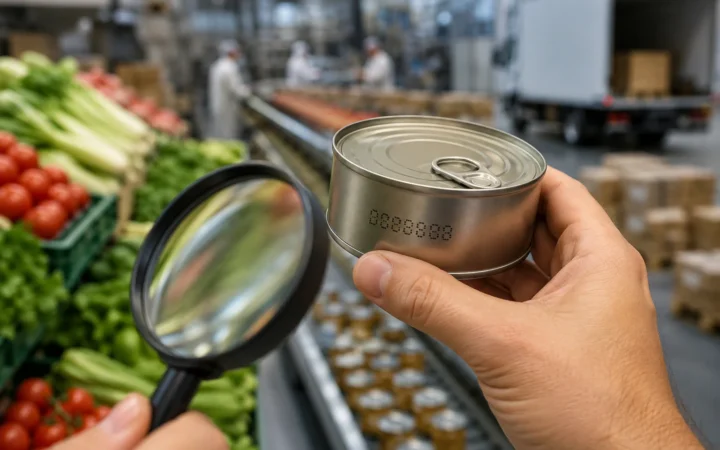
What makes this mechanism verifiable — not just a rumour circulating in online forums — is a specific legal obligation. Since April 2018, Italian law has required every pre-packaged food product to state on its label the address of the production facility or, if different, the packaging facility. This is not optional: failure to include it carries an administrative fine of between €2,000 and €15,000, and the same penalty applies to companies with multiple facilities that do not clearly indicate which one actually produced a given batch.
The rule was not introduced to satisfy the curiosity of the most attentive shoppers. It was introduced for a very concrete reason — the same reason this article connects to the food recall coverage we publish every week. In the event of a safety alert, knowing exactly which facility produced a given food allows authorities to trace the supply chain and narrow the scope of the problem quickly, rather than having to investigate an entire company's output. It is the same principle that, in the recent recall cases we covered, allowed investigators to link two separate recalls within hours because both products, despite carrying different brand names, had been manufactured in the same facility.
For readers, this has one very practical implication: the next time you see a food recall notice, do not stop at the brand name. Look for the production facility — in the recall notice itself, or on the packaging you have at home. That information, more than the name printed large on the front of the pack, is what tells you where a product truly comes from and which other brands might share the same origin.
One app for your whole household
Shopping lists and loyalty cards on every device — free to start, Pro when you want to share in real time.
Real examples, because the abstract version only goes so far
To make a systemic pattern concrete, it helps to look at some documented cases in the dairy and food sector — chosen not because they are exceptional, but precisely because they are representative of a widespread practice.
Sterilgarda Alimenti, Italy's fourth-largest milk producer after Parmalat, Granarolo and Centrale del Latte d'Italia, based in Castiglione delle Stiviere in the province of Mantua, holds BRC-IFS certification — the standard developed specifically by large-scale retail to qualify its own-label product suppliers. Sterilgarda also holds an 8% stake in Padania Alimenti S.r.l., a company that produces milk under the Auchan, Carrefour, Billa and Coop store brands, while also supplying unlabelled milk through Esselunga and selling under its own brand, Epiù. Four different retail chains, often competing directly on the same shelf, partly supplied through the same production network.
Across pasta and grocery, the pattern repeats with different names. The UHT milk in Esselunga's Equilibrio own-label line is produced by Centrale del Latte di Brescia; the durum wheat farfalle sold under the Conad brand come from La Molisana, one of southern-central Italy's most established pasta makers; and the organic blueberry jam on Carrefour's shelves is made by Apicoltura Casentinese, a specialist Tuscan producer. In none of these cases is the information hidden — it is on the label, compliant with the law, simply rarely read.
What these examples share is that the actual producer is not some anonymous, low-quality entity, as a certain narrative long suggested. These are structured, certified companies, often leaders in their sectors, that have chosen to diversify their sales channels by adding retailer-label production alongside their own brand. The quality of the product, to be equally honest, is not automatically identical across both lines. Same facility does not always mean same recipe: the specification document agreed between producer and retailer can call for different ingredients or processes even within the same plant.
Why this is not just a technical footnote
There is a way of reading this supply chain dynamic as a transparency problem for consumers — and partly it is: the brand visible on the shelf tells only part of a product's story. But there is another reading, less often discussed and equally important, that concerns those on the other side of the supply chain: the small and medium-sized Italian food producers who work with large-scale retail, or are trying to break into it.
For a mid-sized food company, understanding how the relationship between production and brand actually works — what labelling obligations apply, how a retailer specification contract is structured — can mean the difference between staying a local supplier and becoming a stable partner for a major retailer. It is a topic that, partly driven by growing public attention to food recall news, is becoming central again in conversations about food safety and short supply chains, and one that deserves dedicated coverage.
This article is the first in a series we will publish over the coming weeks on how the production chain behind the food on our tables actually works: from industrial groups that simultaneously own multiple brands — as in the recent recall we covered — to a practical guide for reading a food label the way an industry professional would, to a reflection on what it means, for small Italian food producers, to work with large-scale retail in an increasingly transparent market.